
Lesson: The Epsilon-Delta Definition of a Limit
By: The Axioma Scholar Team

The epsilon-delta definition of a limit is one of the most precise ideas in calculus.
At first, it can look confusing because it uses new symbols and a very formal style of writing.
But the main idea is actually simple:
If we want $f(x)$ to be close to a certain output value, we need to make $x$ close enough to a certain input value.
This lesson will explain the idea slowly, using examples, graphs, and a step-by-step proof procedure.
1. Review: What Is a Limit?
A limit describes what value a function approaches as $x$ gets close to a certain number.
The notation:
$$ \lim_{x \to a} f(x)=L $$
means:
“As $x$ gets closer and closer to $a$, $f(x)$ gets closer and closer to $L$.”
The number $a$ is the input value that $x$ is approaching.
The number $L$ is the output value that $f(x)$ is approaching.
Example
Consider:
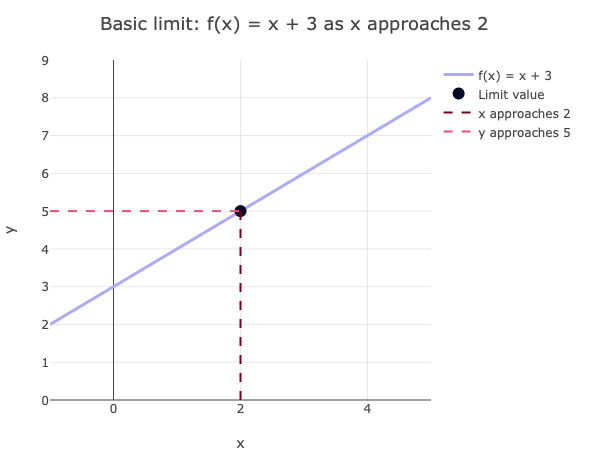
$$ \lim_{x \to 2} (x+3)=5 $$
This means:
As $x$ gets close to $2$, the expression $x+3$ gets close to $5$.
For example:
Notice that when $x$ is close to $2$, $f(x)$ is close to $5$.
2. Why Do We Need Epsilon and Delta?
Saying “$x$ gets close to $a$” is intuitive, but it is not very precise.
A mathematician might ask:
“How close is close?”
The epsilon-delta definition answers that question.
It gives us a precise way to say:
If $x$ is close enough to $a$, then $f(x)$ will be close enough to $L$.
The two important symbols are:
- $\epsilon$, called epsilon
- $\delta$, called delta
Epsilon and delta are both small positive numbers.
3. What Does Epsilon Mean?
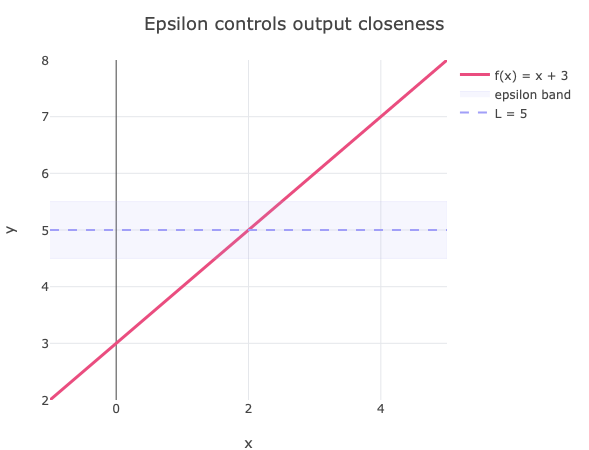
Epsilon, written as $\epsilon$, controls how close $f(x)$ must be to $L$.
In other words:
Epsilon is the allowed error in the output.
If we want $f(x)$ to be close to $L$, we can say:
$$ |f(x)-L|<\epsilon $$
The expression:
$$ |f(x)-L| $$
means the distance between $f(x)$ and $L$.
So:
$$ |f(x)-L|<\epsilon $$
means:
“The output $f(x)$ is less than $\epsilon$ units away from $L$.”
Example
Suppose $L=5$ and $\epsilon=0.1$.
Then:
$$ |f(x)-5|<0.1 $$
means $f(x)$ must be within $0.1$ units of $5$.
That means $f(x)$ must be between:
$$ 4.9 $$
and:
$$ 5.1 $$
So the output must satisfy:
$$ 4.9$$
Epsilon creates a horizontal target band around the limit value $L$.
4. What Does Delta Mean?
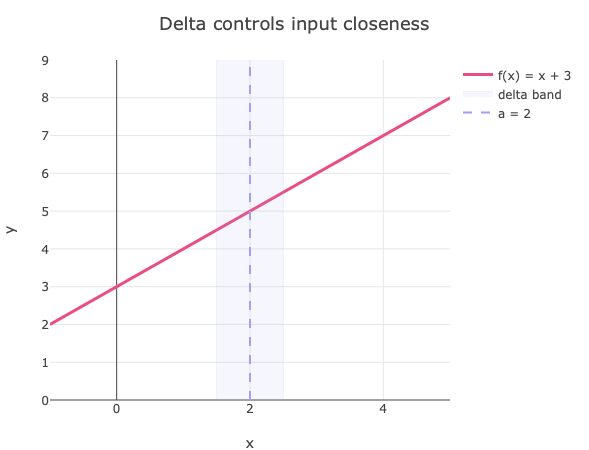
Delta, written as $\delta$, controls how close $x$ must be to $a$.
In other words:
Delta is the allowed error in the input.
If we want $x$ to be close to $a$, we write:
$$ |x-a|<\delta $$
The expression:
$$ |x-a| $$
means the distance between $x$ and $a$.
So:
$$ |x-a|<\delta $$
means:
“The input $x$ is less than $\delta$ units away from $a$.”
Example
Suppose $a=2$ and $\delta=0.1$.
Then:
$$ |x-2|<0.1 $$
means $x$ must be within $0.1$ units of $2$.
That means $x$ must be between:
$$ 1.9 $$
and:
$$ 2.1 $$
So:
$$ 1.9$$
Delta creates a vertical input band around the $x$-value $a$.
5. Epsilon and Delta Together
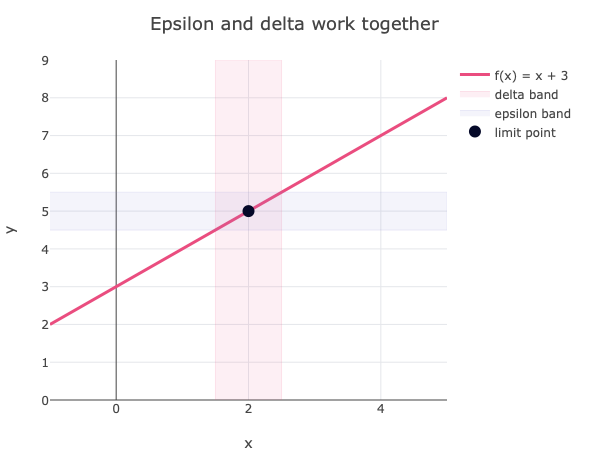
Epsilon and delta work together.
Epsilon tells us how close we want the output to be.
Delta tells us how close the input needs to be in order to make that happen.
The idea is:
For every output target $\epsilon$, we must find an input target $\delta$.
More simply:
If someone tells us how close $f(x)$ needs to be to $L$, we must show how close $x$ needs to be to $a$.
The goal is to make this statement true:
$$ 0<|x-a|<\delta \quad \Rightarrow \quad |f(x)-L|<\epsilon $$
This means:
If $x$ is within $\delta$ of $a$, but $x\neq a$, then $f(x)$ is within $\epsilon$ of $L$.
The condition:
$$ 0<|x-a| $$
means $x$ is not exactly equal to $a$.
This is included because limits care about what happens near $a$, not necessarily at $a$.
6. The Formal Epsilon-Delta Definition
Now we are ready for the full definition.
We say:
$$ \lim_{x \to a} f(x)=L $$
if for every $\epsilon>0$, there exists a $\delta>0$ such that whenever:
$$ 0<|x-a|<\delta $$
then:
$$ |f(x)-L|<\epsilon $$
Same Definition in Plain English
The statement:
$$ \lim_{x \to a} f(x)=L $$
means:
No matter how close someone wants $f(x)$ to be to $L$, we can make that happen by keeping $x$ close enough to $a$.
Epsilon is chosen first. Delta is our response.
This is very important.
In an epsilon-delta proof, you do not get to choose $\epsilon$.
Someone gives you an arbitrary $\epsilon>0$, and your job is to find a $\delta>0$ that works.
7. Why Does the Definition Say “For Every $\epsilon>0$”?
The phrase “for every $\epsilon>0$” means the proof must work for any positive amount of output closeness.
The value of $\epsilon$ could be:
$$ 1 $$
or:
$$ 0.1 $$
or:
$$ 0.000001 $$
It does not matter how small $\epsilon$ is.
We must be able to find a $\delta$ that keeps $f(x)$ within that $\epsilon$-distance from $L$.
The smaller the epsilon, the smaller the delta may need to be.
8. Why Does the Definition Say “There Exists a $\delta>0$”?
The phrase “there exists a $\delta>0$” means we need to find at least one positive delta that works.
We do not need to find the biggest possible delta.
We only need to find a delta small enough to guarantee:
$$ |f(x)-L|<\epsilon $$
whenever:
$$ 0<|x-a|<\delta $$
In epsilon-delta proofs, smaller deltas are usually safer.
If a certain $\delta$ works, then any smaller positive $\delta$ also works.
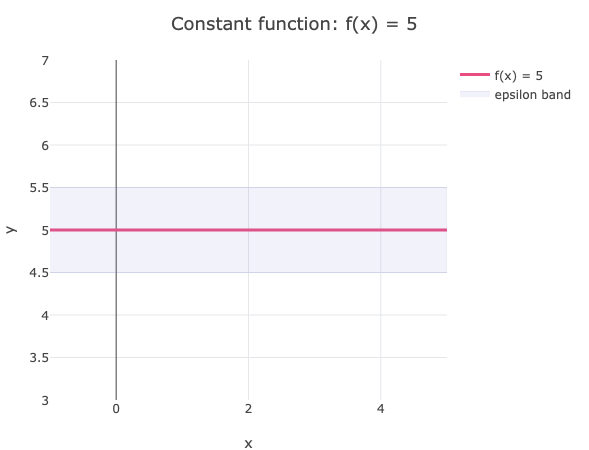
9. Super Easy Example: Prove $\lim_{x \to 2} 5=5$
This is the easiest possible type of limit because the function is constant.
Let:
$$ f(x)=5 $$
We want to prove:
$$ \lim_{x \to 2} 5=5 $$
According to the epsilon-delta definition, we need to show that for every $\epsilon>0$, there exists a $\delta>0$ such that:
$$ 0<|x-2|<\delta $$
implies:
$$ |5-5|<\epsilon $$
Now simplify:
$$ |5-5|=|0|=0 $$
So we need:
$$ 0<\epsilon $$
This is always true because $\epsilon>0$.
That means any positive $\delta$ works.
For example, choose:
$$ \delta=1 $$
Proof
Let $\epsilon>0$.
Choose:
$$ \delta=1 $$
If:
$$ 0<|x-2|<\delta $$
then:
$$ |f(x)-5|=|5-5|=0 $$
Since:
$$ 0<\epsilon $$
we have:
$$ |f(x)-5|<\epsilon $$
Therefore:
$$ \lim_{x \to 2} 5=5 $$
Why This Works
The function is always equal to $5$, so it is always exactly $0$ units away from $5$.
Since $0$ is less than every positive $\epsilon$, the proof is automatic.
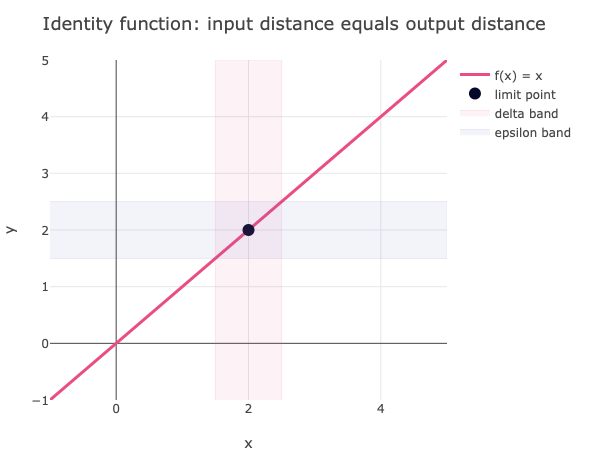
10. Easy Example: Prove $\lim_{x \to 2} x=2$
Now let:
$$ f(x)=x $$
We want to prove:
$$ \lim_{x \to 2} x=2 $$
We need to show that for every $\epsilon>0$, there is a $\delta>0$ such that:
$$ 0<|x-2|<\delta $$
implies:
$$ |x-2|<\epsilon $$
This example is simple because the input distance and output distance are exactly the same.
The output distance is:
$$ |f(x)-L|=|x-2| $$
The input distance is:
$$ |x-a|=|x-2| $$
Since these are the same, we can choose:
$$ \delta=\epsilon $$
Proof
Let $\epsilon>0$.
Choose:
$$ \delta=\epsilon $$
Suppose:
$$ 0<|x-2|<\delta $$
Since $\delta=\epsilon$, we have:
$$ |x-2|<\epsilon $$
But:
$$ |f(x)-2|=|x-2| $$
Therefore:
$$ |f(x)-2|<\epsilon $$
So:
$$ \lim_{x \to 2} x=2 $$
If the output distance is exactly the same as the input distance, choose $\delta=\epsilon$.
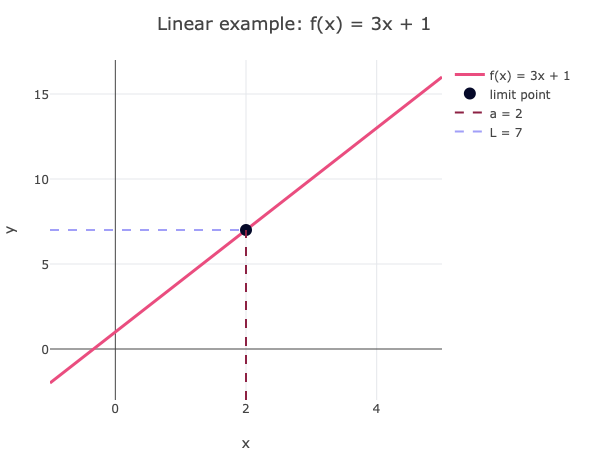
11. Easy Linear Example: Prove $\lim_{x \to 2} (3x+1)=7$
Now consider:
$$ f(x)=3x+1 $$
We want to prove:
$$ \lim_{x \to 2} (3x+1)=7 $$
First, check the limit value:
$$ 3(2)+1=6+1=7 $$
The epsilon-delta proof is about making:
$$ |f(x)-L| $$
less than $\epsilon$.
Here:
$$ f(x)=3x+1 $$
and:
$$ L=7 $$
So:
$$ |f(x)-L|=|(3x+1)-7| $$
Simplify:
$$ |(3x+1)-7|=|3x-6| $$
Factor:
$$ |3x-6|=|3(x-2)| $$
Use the absolute value rule:
$$ |3(x-2)|=3|x-2| $$
So:
$$ |f(x)-L|=3|x-2| $$
We want:
$$ 3|x-2|<\epsilon $$
Divide by $3$:
$$ |x-2|<\frac{\epsilon}{3} $$
That tells us what delta should be:
$$ \delta=\frac{\epsilon}{3} $$
Proof
Let $\epsilon>0$.
Choose:
$$ \delta=\frac{\epsilon}{3} $$
Suppose:
$$ 0<|x-2|<\delta $$
Then:
$$ |x-2|<\frac{\epsilon}{3} $$
Now look at the output distance:
$$ |(3x+1)-7| $$
Simplify:
$$ |(3x+1)-7|=|3x-6| $$
Factor:
$$ |3x-6|=|3(x-2)| $$
Pull out the $3$:
$$ |3(x-2)|=3|x-2| $$
Since:
$$ |x-2|<\frac{\epsilon}{3} $$
we get:
$$ 3|x-2|<3\left(\frac{\epsilon}{3}\right) $$
Therefore:
$$ 3|x-2|<\epsilon $$
So:
$$ |(3x+1)-7|<\epsilon $$
Therefore:
$$ \lim_{x \to 2} (3x+1)=7 $$
For a linear function, simplify $|f(x)-L|$ until it becomes a constant times $|x-a|$.
12. Another Linear Example: Prove $\lim_{x \to 4} (2x-5)=3$
Let:
$$ f(x)=2x-5 $$
We want to prove:
$$ \lim_{x \to 4} (2x-5)=3 $$
First, check the limit value:
$$ 2(4)-5=8-5=3 $$
Start with the output distance:
$$ |f(x)-L|=|(2x-5)-3| $$
Simplify:
$$ |(2x-5)-3|=|2x-8| $$
Factor:
$$ |2x-8|=|2(x-4)| $$
Pull out the constant:
$$ |2(x-4)|=2|x-4| $$
We want:
$$ 2|x-4|<\epsilon $$
Divide by $2$:
$$ |x-4|<\frac{\epsilon}{2} $$
So choose:
$$ \delta=\frac{\epsilon}{2} $$
Proof
Let $\epsilon>0$.
Choose:
$$ \delta=\frac{\epsilon}{2} $$
Suppose:
$$ 0<|x-4|<\delta $$
Then:
$$ |x-4|<\frac{\epsilon}{2} $$
Now:
$$ |(2x-5)-3|=|2x-8|=|2(x-4)|=2|x-4| $$
Since:
$$ |x-4|<\frac{\epsilon}{2} $$
we get:
$$ 2|x-4|<2\left(\frac{\epsilon}{2}\right)=\epsilon $$
Therefore:
$$ |(2x-5)-3|<\epsilon $$
So:
$$ \lim_{x \to 4} (2x-5)=3 $$
13. General Pattern for Linear Functions
Suppose:
$$ f(x)=mx+b $$
and we want to prove:
$$ \lim_{x \to a} (mx+b)=ma+b $$
Start with:
$$ |f(x)-L| $$
Substitute:
$$ |(mx+b)-(ma+b)| $$
Simplify:
$$ |mx+b-ma-b| $$
Cancel $b-b$:
$$ |mx-ma| $$
Factor:
$$ |m(x-a)| $$
Pull out $|m|$:
$$ |m||x-a| $$
To make this less than $\epsilon$, we need:
$$ |m||x-a|<\epsilon $$
So:
$$ |x-a|<\frac{\epsilon}{|m|} $$
Therefore, when $m\neq 0$, a good choice is:
$$ \delta=\frac{\epsilon}{|m|} $$
For $f(x)=mx+b$, the delta usually comes from dividing epsilon by the absolute value of the slope.
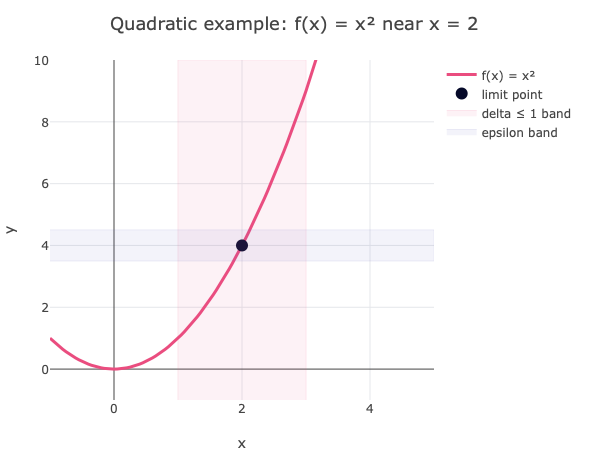
14. Medium Example: Prove $\lim_{x \to 2} x^2=4$
Quadratic functions are slightly harder because $|f(x)-L|$ does not simplify into only a constant times $|x-a|$.
Let:
$$ f(x)=x^2 $$
We want to prove:
$$ \lim_{x \to 2} x^2=4 $$
Start with the output distance:
$$ |f(x)-L|=|x^2-4| $$
Factor:
$$ |x^2-4|=|(x-2)(x+2)| $$
Use the absolute value multiplication rule:
$$ |(x-2)(x+2)|=|x-2||x+2| $$
Now we have:
$$ |x^2-4|=|x-2||x+2| $$
This is harder because it has two factors:
- $|x-2|$, which is the input distance
- $|x+2|$, which is not directly controlled by $\delta$
We need to control $|x+2|$.
Step 1: Force $x$ to Stay Near 2
We can choose $\delta\leq 1$.
This means:
$$ |x-2|<1 $$
This tells us $x$ is within $1$ unit of $2$.
So:
$$ x-2 < 1, \quad -(x-2)<1 $$
If:
$$ |x-2|<1 $$
then:
$$ 1<x<3$$
So:
$$ |x+2|<5 $$
Step 2: Use This Bound
Since:
$$ |x+2|<5 $$
we have:
$$ |x-2||x+2|<5|x-2| $$
We want:
$$ 5|x-2|<\epsilon $$
Divide by $5$:
$$ |x-2|<\frac{\epsilon}{5} $$
So we want both:
$$ |x-2|<1 $$
and:
$$ |x-2|<\frac{\epsilon}{5} $$
To guarantee both are true, choose the smaller one:
$$ \delta=\min\left(1,\frac{\epsilon}{5}\right) $$
Proof
Let $\epsilon>0$.
Choose:
$$ \delta=\min\left(1,\frac{\epsilon}{5}\right) $$
Suppose:
$$ 0<|x-2|<\delta $$
Since:
$$ \delta\leq 1 $$
we know:
$$ |x-2|<1 $$
This implies:
$$ x-2 < 1, \quad -(x-2)<1 $$
Therefore:
$$ 1<x<3 $$
So:
$$ |x+2|<5 $$
Now consider:
$$ |x^2-4| $$
Factor:
$$ |x^2-4|=|(x-2)(x+2)| $$
Rewrite:
$$ |(x-2)(x+2)|=|x-2||x+2| $$
Since:
$$ |x+2|<5 $$
we get:
$$ |x-2||x+2|<5|x-2| $$
Also, since:
$$ \delta\leq \frac{\epsilon}{5} $$
and:
$$ |x-2|<\delta $$
we know:
$$ |x-2|<\frac{\epsilon}{5} $$
Therefore:
$$ 5|x-2|<5\left(\frac{\epsilon}{5}\right)=\epsilon $$
So:
$$ |x^2-4|<\epsilon $$
Therefore:
$$ \lim_{x \to 2} x^2=4 $$
For quadratics, factor $|f(x)-L|$, then use a small delta condition like $\delta\leq 1$ to keep the extra factor under control.
15. Why Do We Use $\min\left(1,\frac{\epsilon}{5}\right)$?
This is one of the most confusing parts for beginners.
We chose:
$$ \delta=\min\left(1,\frac{\epsilon}{5}\right) $$
because we needed two things to be true at the same time.
First, we needed:
$$ |x-2|<1 $$
This allowed us to say:
$$ |x+2|<5 $$
Second, we needed:
$$ |x-2|<\frac{\epsilon}{5} $$
This allowed us to say:
$$ 5|x-2|<\epsilon $$
Choosing the smaller number guarantees both conditions.
The minimum function lets us combine multiple delta requirements into one safe choice.
16. Another Quadratic Example: Prove $\lim_{x \to 1} x^2=1$
Let:
$$ f(x)=x^2 $$
We want to prove:
$$ \lim_{x \to 1} x^2=1 $$
Start with:
$$ |f(x)-L|=|x^2-1| $$
Factor:
$$ |x^2-1|=|(x-1)(x+1)| $$
Rewrite:
$$ |(x-1)(x+1)|=|x-1||x+1| $$
We want this to be less than $\epsilon$.
The factor $|x-1|$ is useful because it matches the input distance.
But we need to control $|x+1|$.
Choose $\delta\leq 1$.
Then:
$$ |x-1|<1 $$
This means:
$$ 0 < x < 2 $$
Therefore:
$$ |x+1|<3 $$
Now:
$$ |x^2-1|=|x-1||x+1|<3|x-1| $$
We want:
$$ 3|x-1|<\epsilon $$
So:
$$ |x-1|<\frac{\epsilon}{3} $$
Choose:
$$ \delta=\min\left(1,\frac{\epsilon}{3}\right) $$
Proof
Let $\epsilon>0$.
Choose:
$$ \delta=\min\left(1,\frac{\epsilon}{3}\right) $$
Suppose:
$$ 0<|x-1|<\delta $$
Since $\delta\leq 1$, we have:
$$ |x-1|<1 $$
So:
$$ 0 < x < 2 $$
Therefore:
$$ |x+1|<3 $$
Now:
$$ |x^2-1|=|(x-1)(x+1)|=|x-1||x+1| $$
Since:
$$ |x+1|<3 $$
we get:
$$ |x-1||x+1|<3|x-1| $$
Since:
$$ \delta\leq \frac{\epsilon}{3} $$
and:
$$ |x-1|<\delta $$
we have:
$$ |x-1|<\frac{\epsilon}{3} $$
Therefore:
$$ 3|x-1|<3\left(\frac{\epsilon}{3}\right)=\epsilon $$
So:
$$ |x^2-1|<\epsilon $$
Therefore:
$$ \lim_{x \to 1} x^2=1 $$
17. Medium-Hard Example: Prove $\lim_{x \to 3} (x^2+2)=11$
Let:
$$ f(x)=x^2+2 $$
We want to prove:
$$ \lim_{x \to 3} (x^2+2)=11 $$
First, check the limit value:
$$ 3^2+2=9+2=11 $$
Start with:
$$ |f(x)-L|=|(x^2+2)-11| $$
Simplify:
$$ |(x^2+2)-11|=|x^2-9| $$
Factor:
$$ |x^2-9|=|(x-3)(x+3)| $$
Rewrite:
$$ |(x-3)(x+3)|=|x-3||x+3| $$
We need to control $|x+3|$.
Choose $\delta\leq 1$.
Then:
$$ |x-3|<1 $$
This means:
$$ 2 < x < 4 $$
Add $3$ to each part:
$$ 5 < x + 3 < 7 $$
So:
$$ |x+3|<7 $$
Now:
$$ |x^2-9|=|x-3||x+3|<7|x-3| $$
We want:
$$ 7|x-3|<\epsilon $$
So:
$$ |x-3|<\frac{\epsilon}{7} $$
Choose:
$$ \delta=\min\left(1,\frac{\epsilon}{7}\right) $$
Proof
Let $\epsilon>0$.
Choose:
$$ \delta=\min\left(1,\frac{\epsilon}{7}\right) $$
Suppose:
$$ 0<|x-3|<\delta $$
Since $\delta\leq 1$, we know:
$$ |x-3|<1 $$
This implies:
$$ 2 < x < 4 $$
Therefore:
$$ |x+3|<7 $$
Now:
$$ |(x^2+2)-11|=|x^2-9| $$
Factor:
$$ |x^2-9|=|(x-3)(x+3)| $$
Rewrite:
$$ |(x-3)(x+3)|=|x-3||x+3| $$
Since:
$$ |x+3|<7 $$
we get:
$$ |x-3||x+3|<7|x-3| $$
Since:
$$ \delta\leq \frac{\epsilon}{7} $$
and:
$$ |x-3|<\delta $$
we know:
$$ |x-3|<\frac{\epsilon}{7} $$
Therefore:
$$ 7|x-3|<7\left(\frac{\epsilon}{7}\right)=\epsilon $$
So:
$$ |(x^2+2)-11|<\epsilon $$
Therefore:
$$ \lim_{x \to 3} (x^2+2)=11 $$
18. How to Discover Delta Before Writing the Proof
In epsilon-delta proofs, students often wonder:
“How did you know what $\delta$ should be?”
The answer is:
We usually do scratch work first.
The scratch work starts from the expression we want to make small:
$$ |f(x)-L| $$
Then we try to rewrite it in terms of:
$$ |x-a| $$
because $|x-a|$ is the expression controlled by $\delta$.
Scratch Work Pattern
- Start with $|f(x)-L|$.
- Simplify and factor if possible.
- Try to find an expression involving $|x-a|$.
- Control any extra factors by forcing $\delta\leq 1$, or another convenient number.
- Solve for how small $|x-a|$ needs to be.
- Choose $\delta$ based on that result.
19. General Procedure for Writing an Epsilon-Delta Proof
Here is a simple procedure you can follow.
Step 1: Identify $a$, $f(x)$, and $L$
From the limit:
$$ \lim_{x \to a} f(x)=L $$
identify:
- $a$: the $x$-value being approached
- $f(x)$: the function
- $L$: the limit value
Step 2: Start with $|f(x)-L|$
This is the output distance.
Your goal is to make:
$$ |f(x)-L|<\epsilon $$
Step 3: Rewrite $|f(x)-L|$ Using $|x-a|$
Try algebra:
- Simplify
- Factor
- Cancel
- Use absolute value rules
The goal is to connect the output distance to the input distance.
Step 4: Decide What $\delta$ Should Be
If you get something like:
$$ |f(x)-L|\leq C|x-a| $$
then choose:
$$ \delta=\frac{\epsilon}{C} $$
If you need an extra condition, such as $\delta\leq 1$, choose:
$$ \delta=\min\left(1,\frac{\epsilon}{C}\right) $$
Step 5: Write the Proof
A standard proof format looks like this:
Let $\epsilon>0$.
Choose $\delta=\text{your expression}$.
Suppose $0<|x-a|<\delta$.
Then show step by step that:
$$ |f(x)-L|<\epsilon $$
Therefore:
$$ \lim_{x \to a} f(x)=L $$
The proof always starts with $\epsilon$, chooses $\delta$, assumes $0<|x-a|<\delta$, and ends by proving $|f(x)-L|<\epsilon$.
20. A Simple Proof Template You Can Copy
Here is a fill-in-the-blank template.
We want to prove:
$$ \lim_{x \to a} f(x)=L $$
Let $\epsilon>0$.
Choose:
$$ \delta= \cdots$$
Suppose:
$$ 0<|x-a|<\delta $$
Then:
$$ |f(x)-L| = \cdots $$
Continue simplifying until you get:
$$ |f(x)-L|<\epsilon $$
Therefore:
$$ \lim_{x \to a} f(x)=L $$
21. Practice Example with Guided Setup
Prove:
$$ \lim_{x \to 5} (4x-1)=19 $$
Step 1: Identify the pieces
Here:
$$ a=5 $$
$$ f(x)=4x-1 $$
$$ L=19 $$
Step 2: Start with $|f(x)-L|$
$$ |f(x)-L|=|(4x-1)-19| $$
Simplify:
$$ |(4x-1)-19|=|4x-20| $$
Factor:
$$ |4x-20|=|4(x-5)| $$
Pull out the $4$:
$$ |4(x-5)|=4|x-5| $$
We want:
$$ 4|x-5|<\epsilon $$
So:
$$ |x-5|<\frac{\epsilon}{4} $$
Choose:
$$ \delta=\frac{\epsilon}{4} $$
Full Proof
Let $\epsilon>0$.
Choose:
$$ \delta=\frac{\epsilon}{4} $$
Suppose:
$$ 0<|x-5|<\delta $$
Then:
$$ |x-5|<\frac{\epsilon}{4} $$
Now:
$$ |(4x-1)-19|=|4x-20|=|4(x-5)|=4|x-5| $$
Since:
$$ |x-5|<\frac{\epsilon}{4} $$
we get:
$$ 4|x-5|<4\left(\frac{\epsilon}{4}\right)=\epsilon $$
Therefore:
$$ |(4x-1)-19|<\epsilon $$
So:
$$ \lim_{x \to 5} (4x-1)=19 $$
22. Common Mistakes to Avoid
Mistake 1: Choosing $\epsilon$
In a proof, you do not choose $\epsilon$.
You say:
$$ \text{Let } \epsilon>0 $$
This means the proof must work for any positive epsilon.
Mistake 2: Forgetting to Choose $\delta$
The main job of the proof is to find a delta that works.
Always clearly write:
$$ \text{Choose } \delta=\cdots $$
Mistake 3: Starting with $|x-a|$ Instead of $|f(x)-L|$
In your scratch work, it is helpful to begin with:
$$ |f(x)-L| $$
because this is what you need to make less than $\epsilon$.
Mistake 4: Forgetting the Absolute Value
Epsilon-delta proofs are based on distance.
Distance is measured with absolute value.
So do not forget the absolute value bars.
Mistake 5: Thinking $\delta$ Must Be Unique
Delta does not have to be unique.
Many different deltas may work.
Your job is only to find one valid positive delta.
23. Final Summary
The epsilon-delta definition makes the idea of a limit precise.
The statement:
$$ \lim_{x \to a} f(x)=L $$
means:
For every $\epsilon>0$, there exists a $\delta>0$ such that if:
$$ 0<|x-a|<\delta $$
then:
$$ |f(x)-L|<\epsilon $$
In plain English:
No matter how close we want $f(x)$ to be to $L$, we can make it happen by keeping $x$ close enough to $a$.
24. Final Key Ideas
- $\epsilon$ controls output closeness.
- $\delta$ controls input closeness.
- $|f(x)-L|$ measures how far the output is from the limit.
- $|x-a|$ measures how far the input is from the target $x$-value.
- The proof starts with an arbitrary $\epsilon>0$.
- Your job is to choose a $\delta>0$.
- You must show that $0<|x-a|<\delta$ forces $|f(x)-L|<\epsilon$.
Most importantly:
An epsilon-delta proof is just a careful way of showing that controlling the input controls the output.
Ready to practice?

Turn this lesson into real progress with adaptive practice that responds to how you're learning and helps guide you toward mastery.