
Lesson: The Limit Definition of a Derivative
By: The Axioma Scholar Team

In calculus, a derivative tells us how fast something is changing at one exact moment.
Before we can understand the derivative, we need to understand three related ideas:
- Average rate of change
- Secant lines
- Instantaneous rate of change
These ideas lead directly to the limit definition of a derivative.
1. What Is a Rate of Change?
A rate of change describes how much one quantity changes compared to another quantity.
In calculus, we usually study how a function value $f(x)$ changes as $x$ changes.
If $x$ changes from one value to another, and $f(x)$ also changes, we can ask:
“How much did the output change compared to the input?”
This is the basic idea behind slope.
The slope between two points is:
$$\text{slope}=\frac{\text{change in }y}{\text{change in }x}$$
In function notation, since $y=f(x)$, this becomes:
$$ \text{slope}=\frac{\text{change in }f(x)}{\text{change in }x} $$
2. Average Rate of Change
The average rate of change measures how much a function changes over an interval.
Suppose we have a function $f(x)$, and we want to measure its change from $x=a$ to $x=b$.
The two points on the graph are:
$$ (a,f(a)) $$
and:
$$ (b,f(b)) $$
The change in the output is:
$$ f(b)-f(a) $$
The change in the input is:
$$ b-a $$
So the average rate of change is:
$$ \frac{f(b)-f(a)}{b-a} $$
This is the same formula as slope between two points.
Average rate of change tells us how fast a function changes over an interval, not at one exact point.
Example 1: Average Rate of Change
Consider the function:
$$ f(x)=x^2 $$
Find the average rate of change from $x=1$ to $x=3$.
First, find the function values:
$$ f(1)=1^2=1 $$
$$ f(3)=3^2=9 $$
Now use the average rate of change formula:
$$ \frac{f(3)-f(1)}{3-1} $$
Substitute:
$$ \frac{9-1}{3-1} = \frac{8}{2} = 4 $$
Therefore, the average rate of change from $x=1$ to $x=3$ is:
$$ 4 $$
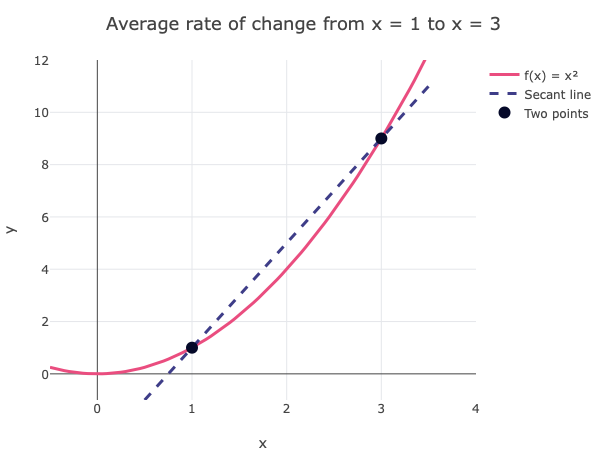
On the graph, the line connecting the two points $(1,1)$ and $(3,9)$ shows the average rate of change.
3. What Is a Secant Line?
A secant line is a line that passes through two points on a curve.
For the function $f(x)=x^2$, the points $(1,1)$ and $(3,9)$ are both on the curve.
The secant line connects those two points.
The slope of the secant line is the average rate of change.
So these two ideas are closely connected:
- The secant line is the visual line on the graph.
- The average rate of change is the slope of that line.
In other words:
$$ \text{average rate of change}=\text{slope of the secant line} $$
A secant line uses two different points on a graph.
This is important because a derivative is different. A derivative measures change at one exact point, not over two separated points.
4. Rewriting Average Rate of Change Using $h$
The average rate of change from $x=a$ to $x=b$ is:
$$ \frac{f(b)-f(a)}{b-a} $$
Instead of using $b$, calculus often writes the second $x$-value as:
$$ a+h $$
Here, $h$ represents the horizontal distance between the two $x$-values.
So the two $x$-values are:
$$ a $$
and:
$$ a+h $$
The two points on the graph are:
$$ (a,f(a)) $$
and:
$$ (a+h,f(a+h)) $$
The change in $y$ is:
$$ f(a+h)-f(a) $$
The change in $x$ is:
$$ (a+h)-a $$
Simplify the denominator:
$$ (a+h)-a=h $$
Therefore, the average rate of change from $x=a$ to $x=a+h$ is:
$$ \frac{f(a+h)-f(a)}{h} $$
The expression $\frac{f(a+h)-f(a)}{h}$ is still an average rate of change.
It is not the derivative yet.
It becomes connected to the derivative when we let $h$ get closer and closer to $0$.
5. Why Do We Let $h$ Approach $0$?
The value $h$ measures how far apart the two $x$-values are.
If $h$ is large, the two points are far apart.
If $h$ is small, the two points are close together.
For example, if $a=1$:
- If $h=2$, the second point is at $x=3$.
- If $h=1$, the second point is at $x=2$.
- If $h=0.1$, the second point is at $x=1.1$.
- If $h=0.01$, the second point is at $x=1.01$.
As $h$ gets closer to $0$, the second point gets closer and closer to the first point.
The secant line then gets closer and closer to the tangent line.
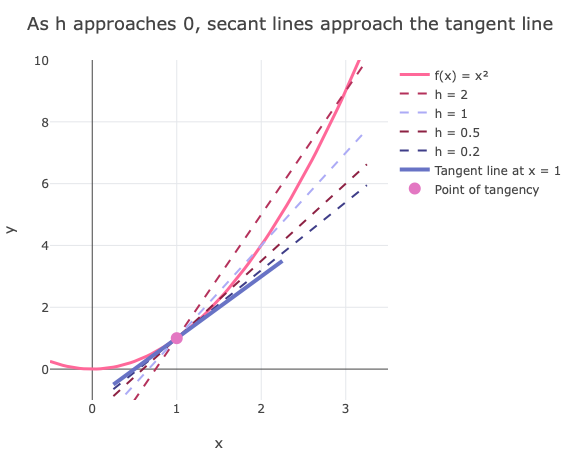
The graph above shows several secant lines. As the second point gets closer to the first point, the secant line begins to look more like the tangent line.
6. What Is a Tangent Line?
A tangent line is a line that represents the direction of a curve at one exact point.
For a straight line, the slope is the same everywhere.
But for a curve, the slope changes from point to point.
The tangent line helps us describe the slope of the curve at one specific point.
For example, on the graph of:
$$ f(x)=x^2 $$
the curve is steeper at some places than others.
The tangent line at $x=1$ gives the slope of the curve exactly at $x=1$.
The tangent line uses one point and describes the curve's direction at that exact point.
7. Instantaneous Rate of Change
The instantaneous rate of change measures how fast a function is changing at one exact input value.
This is different from average rate of change.
The derivative gives us the instantaneous rate of change.
The derivative gives us the instantaneous rate of change.
So:
$$ \text{derivative}=\text{instantaneous rate of change} $$
and:
$$ \text{derivative}=\text{slope of the tangent line} $$
8. The Limit Definition of a Derivative
Now we can define the derivative.
We start with the average rate of change from $x=a$ to $x=a+h$:
$$ \frac{f(a+h)-f(a)}{h} $$
This gives the slope of a secant line.
To get the slope at one exact point, we let $h$ approach $0$.
That gives the limit definition of the derivative:
$$ f'(a)=\lim_{h \to 0}\frac{f(a+h)-f(a)}{h} $$
This is read as:
“The derivative of $f$ at $a$ is the limit as $h$ approaches $0$ of $\frac{f(a+h)-f(a)}{h}$.”
The derivative is not just the average rate of change. It is the limit of the average rate of change as the interval becomes extremely small.
9. What Each Part of the Formula Means
In the formula:
$$ f'(a)=\lim_{h \to 0}\frac{f(a+h)-f(a)}{h} $$
each part has a meaning.
10. Quick Derivation of the Limit Definition
We can build the limit definition step by step.
Start with two points on the curve:
$$ (a,f(a)) $$
and:
$$ (a+h,f(a+h)) $$
The slope between two points is:
$$ \frac{y_2-y_1}{x_2-x_1} $$
For our two points:
$$ y_2=f(a+h) $$
$$ y_1=f(a) $$
$$ x_2=a+h $$
$$ x_1=a $$
Substitute these into the slope formula:
$$ \frac{f(a+h)-f(a)}{(a+h)-a} $$
Simplify the denominator:
$$ (a+h)-a=h $$
So the secant slope is:
$$ \frac{f(a+h)-f(a)}{h} $$
This is the average rate of change between $a$ and $a+h$.
To turn this into an instantaneous rate of change, we shrink $h$ toward $0$:
$$ \lim_{h \to 0}\frac{f(a+h)-f(a)}{h} $$
Therefore:
$$ f'(a)=\lim_{h \to 0}\frac{f(a+h)-f(a)}{h} $$
The derivative comes from taking the slope formula between two points and moving the second point closer and closer to the first point.
11. Example: Using the Limit Definition
Let:
$$ f(x)=x^2 $$
Find $f'(a)$ using the limit definition.
Start with:
$$ f'(a)=\lim_{h \to 0}\frac{f(a+h)-f(a)}{h} $$
Since $f(x)=x^2$, we have:
$$ f(a)=a^2 $$
and:
$$ f(a+h)=(a+h)^2 $$
Substitute:
$$ f'(a)=\lim_{h \to 0}\frac{(a+h)^2-a^2}{h} $$
Expand:
$$ (a+h)^2=a^2+2ah+h^2 $$
So:
$$ f'(a)=\lim_{h \to 0}\frac{a^2+2ah+h^2-a^2}{h} $$
Cancel $a^2-a^2$:
$$ f'(a)=\lim_{h \to 0}\frac{2ah+h^2}{h} $$
Factor out $h$:
$$ f'(a)=\lim_{h \to 0}\frac{h(2a+h)}{h} $$
Cancel the $h$:
$$ f'(a)=\lim_{h \to 0}(2a+h) $$
Now take the limit as $h \to 0$:
$$ f'(a)=2a $$
Therefore, for:
$$ f(x)=x^2 $$
the derivative is:
$$ f'(x)=2x $$
This means the slope of the graph $f(x)=x^2$ at any point $x$ is $2x$.
12. Example: Instantaneous Rate of Change at $x=1$
Since:
$$ f'(x)=2x $$
the derivative at $x=1$ is:
$$ f'(1)=2(1)=2 $$
This means the instantaneous rate of change of $f(x)=x^2$ at $x=1$ is: $$ 2 $$
It also means the slope of the tangent line at $x=1$ is $2$.
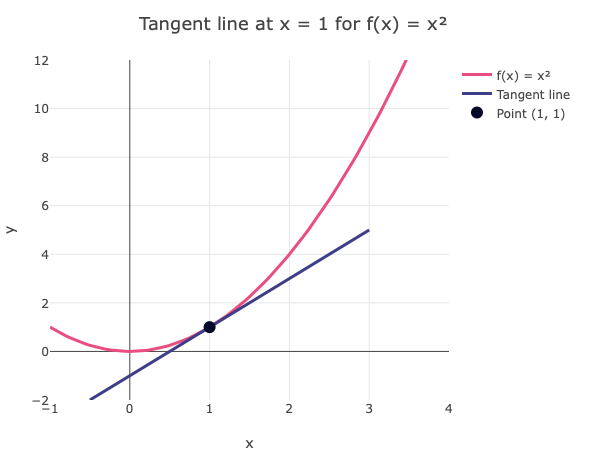
In the graph above, the tangent line touches the curve at $x=1$ and has slope $2$.
13. Secant Line vs. Tangent Line
The secant line and tangent line are related, but they are not the same.
A secant line gives an average slope over an interval.
A tangent line gives the slope at one exact point.
The derivative is the slope of the tangent line.
14. Average Rate of Change vs. Derivative
It is important not to confuse average rate of change with the derivative.
The average rate of change is:
$$ \frac{f(b)-f(a)}{b-a} $$
or, using $h$:
$$ \frac{f(a+h)-f(a)}{h} $$
This measures change across an interval.
The derivative is:
$$ f'(a)=\lim_{h \to 0}\frac{f(a+h)-f(a)}{h} $$
This measures change at one exact point.
The derivative is the limit of average rates of change, not just one average rate of change.
15. Why the Derivative Is Useful
The derivative tells us how quickly something is changing at a specific moment.
For example:
- If $f(x)$ represents position, then $f'(x)$ represents velocity.
- If $f(x)$ represents profit, then $f'(x)$ represents how fast profit is changing.
- If $f(x)$ represents temperature, then $f'(x)$ represents how fast temperature is changing.
In general:
$$ f'(x) $$
tells us the instantaneous rate of change of $f(x)$.
16. Common Beginner Mistakes
Mistake 1: Thinking the derivative is just slope between two points
The slope between two points is an average rate of change.
The derivative is what happens when those two points get infinitely close together.
Mistake 2: Forgetting the limit
The expression:
$$ \frac{f(a+h)-f(a)}{h} $$
is not the full derivative.
The full derivative is:
$$ \lim_{h \to 0}\frac{f(a+h)-f(a)}{h} $$
Mistake 3: Plugging in $h=0$ too early
If you plug in $h=0$ immediately, you often get:
$$ \frac{0}{0} $$
This is why we simplify first, then take the limit.
17. Practice Examples
Practice Example 1
What does the average rate of change represent?
It represents the slope of a secant line between two points.
Practice Example 2
What does the derivative represent?
It represents the instantaneous rate of change at one point.
Practice Example 3
What is the limit definition of the derivative?
$$ f'(a)=\lim_{h \to 0}\frac{f(a+h)-f(a)}{h} $$
Practice Example 4
For $f(x)=x^2$, what is $f'(x)$?
From the limit definition:
$$ f'(x)=2x $$
Practice Example 5
For $f(x)=x^2$, what is the instantaneous rate of change at $x=4$?
Since:
$$ f'(x)=2x $$
substitute $x=4$:
$$ f'(4)=2(4)=8 $$
So the instantaneous rate of change at $x=4$ is:
$$ 8 $$
18. Final Key Idea
The derivative is built from the idea of slope.
First, we find the slope between two points. This gives the average rate of change.
Then, we move the two points closer and closer together.
As the second point approaches the first point, the secant line approaches the tangent line.
The slope of that tangent line is the derivative.
Most importantly:
The derivative is the instantaneous rate of change, found by taking the limit of average rates of change.
Ready to practice?

Turn this lesson into real progress with adaptive practice that responds to how you're learning and helps guide you toward mastery.