
Lesson: The Definition of a Limit
By: The Axioma Scholar Team

In calculus, a limit is one of the most important ideas.
A limit helps us describe what a function is approaching, even if the function does not actually reach that value.
This lesson explains what limits mean, how to read limit notation, and how left-hand and right-hand limits work
1. The Big Idea of a Limit
A limit describes what value a function gets closer and closer to as $x$ gets closer and closer to a certain number.
The notation looks like this: $$\lim_{x \to a} f(x)=L$$ This is read as: "The limit of $f(x)$ as $x$ approaches $a$ is $L$."
This means: As $x$ gets closer and closer to $a$, the output $f(x)$ gets closer and closer to $L$.
The number $a$ is the $x$-value we are approaching.
The number $L$ is the $y$-value the function is approaching.
Example 1: A Basic Limit
Consider the function: $$f(x)=x+2$$
We want to find: $$\lim_{x \to 3} (x+2)$$
This asks:
"As $x$ gets closer to $3$, what does $x+2$ get closer to?"
If $x=3$, then: $$x+2=3+2=5$$
So: $$\lim_{x \to 3} (x+2)=5$$
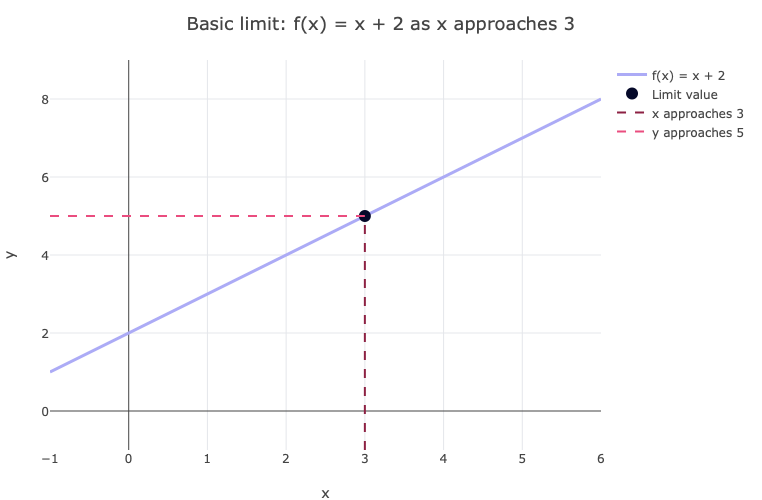
On the graph, as $x$ moves closer to $3$, the graph moves closer to the height $y=5$.
That is why the limit is $5$.
2. Limits Are About Approaching, Not Always Equaling
A very important idea is:
A limit is about what the function approaches, not necessarily what the function equals.
This means the function does not always need to be defined at the exact $x$-value.
For example, a graph might have a hole at a point, but the graph can still approach a clear $y$-value.
If the graph approaches $y=4$ as $x$ approaches $2$, then:
$$\lim_{x \to 2} f(x)=4$$ even if $f(2)$ does not exist.
Example 2: A Limit with a Hole
Consider the function: $$f(x)=\frac{x^2-4}{x-2}$$
At $x=2$, this function is undefined because the denominator becomes zero: $$x-2=2-2=0$$
However, we can simplify the expression: $$\frac{x^2-4}{x-2}=\frac{(x-2)(x+2)}{x-2}$$
For values of $x$ near $2$, but not exactly equal to $2$, the expression behaves like:$$f(x)=x+2$$
So as $x$ approaches $2$, the function approaches: $$2+2=4$$
Therefore: $$\lim_{x \to 2} \frac{x^2-4}{x-2}=4$$
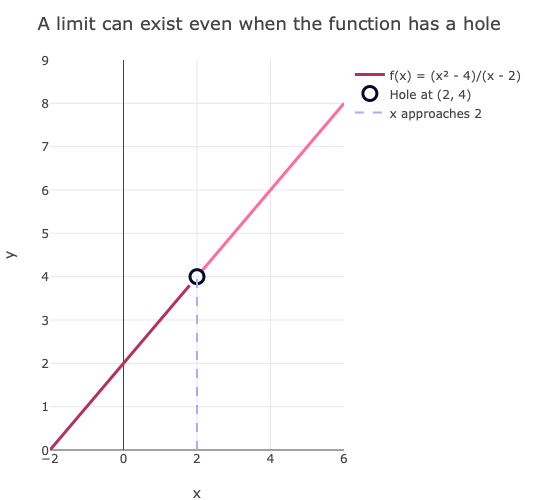
The open circle shows that the function is missing a value at $x=2$. But the graph still approaches $y=4$ from both sides, so the limit exists.
3. Approaching from the Left and Right
When $x$ approaches a number, it can approach from two directions.
It can approach from the left side, using values smaller than the number.
It can also approach from the right side, using values larger than the number.
For example, if $x$ is approaching $3$, then values from the left might be: $$2.9,\ 2.99,\ 2.999$$
These values are less than $3$, but they are getting closer and closer to $3$.
Values from the right might be: $$3.1,\ 3.01,\ 3.001$$
These values are greater than $3$, but they are also getting closer and closer to $3$.
4. Left-Hand Limits
A left-hand limit describes what the function approaches as $x$ gets closer to a number from the left side.
The notation is: $$\lim_{x \to a^-} f(x)=L$$
This is read as: "The limit of $f(x)$ as $x$ approaches $a$ from the left is $L$."
The small minus sign in $a^-$ means we are approaching $a$ using values less than $a$.
Example 3: Left-Hand Limit
Suppose: $$f(x)=x^2$$
We want: $$\lim_{x \to 2^-} x^2$$
This means $x$ approaches $2$ from the left.
So $x$ might be: $$1.9,\ 1.99,\ 1.999$$
The function values are: $$1.9^2=3.61$$ $$1.99^2=3.9601$$ $$1.999^2=3.996001$$
These values are getting closer and closer to $4$.
Therefore: $$\lim_{x \to 2^-} x^2=4$$.
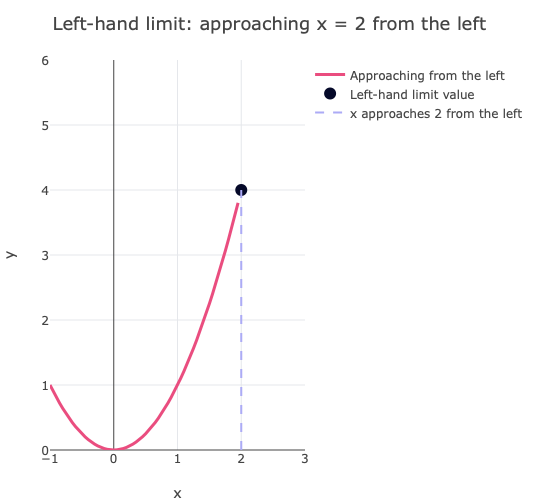
The left side of the graph approaches $y=4$ as $x$ approaches $2$.
5. Right-Hand Limits
A right-hand limit describes what the function approaches as $x$ gets closer to a number from the right side.
The notation is: $$\lim_{x \to a^+} f(x)=L$$ This is read as: "The limit of $f(x)$ as $x$ approaches $a$ from the right is $L$."
The small plus sign in $a^+$ means we are approaching $a$ using values greater than $a$.
Example 4: Right-Hand Limit
Again, suppose: $$f(x)=x^2$$
We want: $$\lim_{x \to 2^+} x^2$$
This means $x$ approaches $2$ from the right.
So $x$ might be: $$2.1,\ 2.01,\ 2.001$$
The function values are: $$2.1^2=4.41$$ $$2.01^2=4.0401$$ $$2.001^2=4.004001$$
These values are getting closer and closer to $4$.
Therefore: $$\lim_{x \to 2^+} x^2=4$$
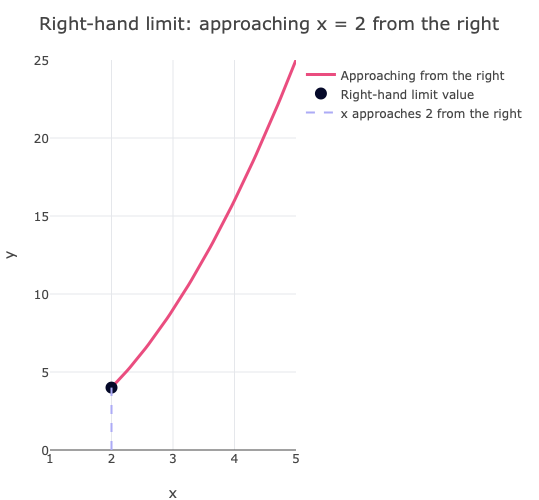
The right side of the graph also approaches $y=4$ as $x$ approaches $2$.
6. Two-Sided Limits
A regular limit is called a two-sided limit.
The notation is: $$\lim_{x \to a} f(x)$$
A two-sided limit asks what happens as $x$ approaches $a$ from both sides.
For the two-sided limit to exist, the left-hand limit and the right-hand limit must be equal.
In other words: $$\lim_{x \to a} f(x)=L$$ only if: $$\lim_{x \to a^-} f(x)=L$$ and: $$\lim_{x \to a^+} f(x)=L$$ So the left side and right side must approach the same value.
Example 5: A Two-Sided Limit That Exists
For: $$f(x)=x^2$$
we found: $$\lim_{x \to 2^-} x^2=4$$
and: $$\lim_{x \to 2^+} x^2=4$$
Since both one-sided limits are equal: $$\lim_{x \to 2} x^2=4$$
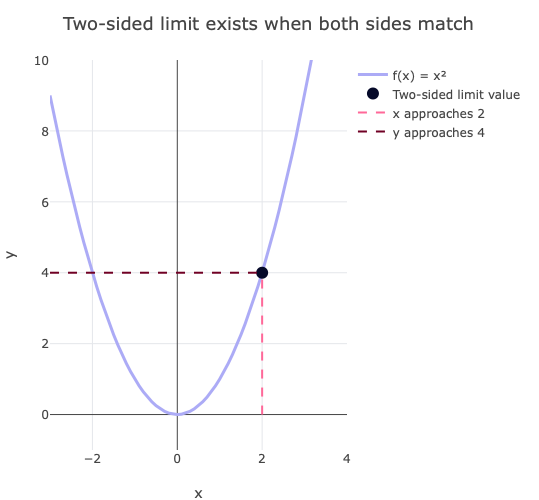
The graph approaches the same height from the left and from the right.
That is why the two-sided limit exists.
7. When a Two-Sided Limit Does Not Exist
A two-sided limit does not exist if the left-hand limit and right-hand limit are different.
This often happens when the graph jumps from one height to another.
Example 6: A Jump Discontinuity
Suppose:
$$f(x)=\begin{cases}2, & x<1 \\ 5, & x>1\end{cases}$$
As $x$ approaches $1$ from the left, the function approaches $2$:
$$\lim_{x \to 1^-} f(x)=2$$
As $x$ approaches $1$ from the right, the function approaches $5$:
$$\lim_{x \to 1^+} f(x)=5$$
Since: $$2 \ne 5$$
the two-sided limit does not exist
Therefore:
$$\lim_{x \to 1} f(x) \text{ does not exist}$$
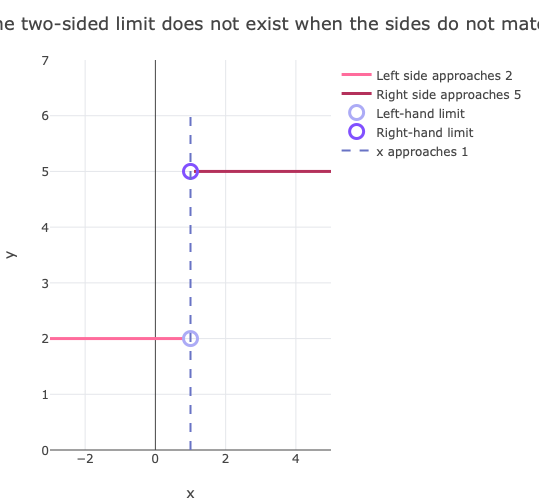
The graph approaches one height from the left and a different height from the right.
Since the two sides do not match, the two-sided limit does not exist.
8. The Function Value Does Not Decide the Limit
A common beginner mistake is thinking that the limit must equal the function value.
But the function value and the limit are different ideas.
The function value $f(a)$ tells us what happens exactly at $x=a$.
The limit $\lim_{x \to a} f(x)$ tells us what happens as $x$ gets close to $a$.
These can be the same, but they do not have to be.
Example 7: Function Value Different from Limit
Suppose the graph approaches $y=4$ as $x$ approaches $2$, but the actual filled point is at $y=1$.
Then: $$\lim_{x \to 2} f(x)=4$$
but: $$f(2)=1$$
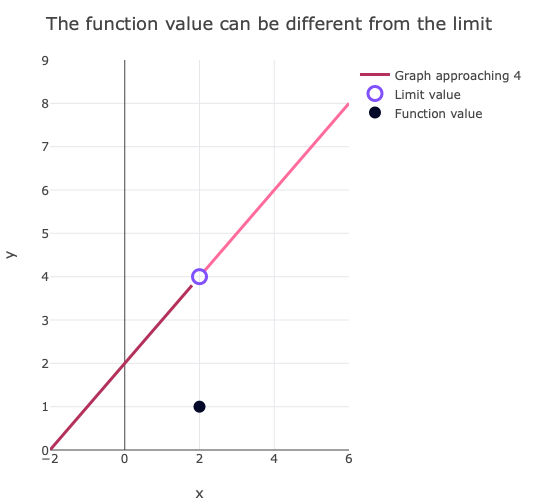
The open circle shows what the graph approaches.
The filled dot shows the actual function value.
Since the graph approaches $4$ from both sides, the limit is $4$.
Since the filled dot is at $1$, the function value is $1$.
9. Informal Definition of a Limit
A beginner-friendly definition of a limit is:
The limit of $f(x)$ as $x$ approaches $a$ is $L$ if we can make $f(x)$ as close as we want to $L$ by making $x$ close enough to $a$, without needing $x$ to actually equal $a$.
Symbolically: $$\lim_{x \to a} f(x)=L$$ means:
"When $x$ is very close to $a$, $f(x)$ is very close to $L$."
The phrase "very close" is the key idea.
Calculus uses limits to make this idea mathematically precise.
10. A More Precise Way to Think About Limits
The formal definition of a limit is usually called the epsilon-delta definition.
You do not need to fully master it when you are brand new to calculus, but it is useful to understand the idea.
The formal definition says: $$\lim_{x \to a} f(x)=L$$
if we can make the distance between $f(x)$ and $L$ as small as we want by making the distance between $x$ and $a$ small enough.
Using symbols, the distance between $f(x)$ and $L$ is: $$|f(x)-L|$$
The distance between $x$ and $a$ is: $$|x-a|$$
So the idea is:
If $x$ is close enough to $a$, then $f(x)$ will be close enough to $L$
In beginner language:
Control how close $x$ is to $a$, and you can control how close $f(x)$ is to $L$.
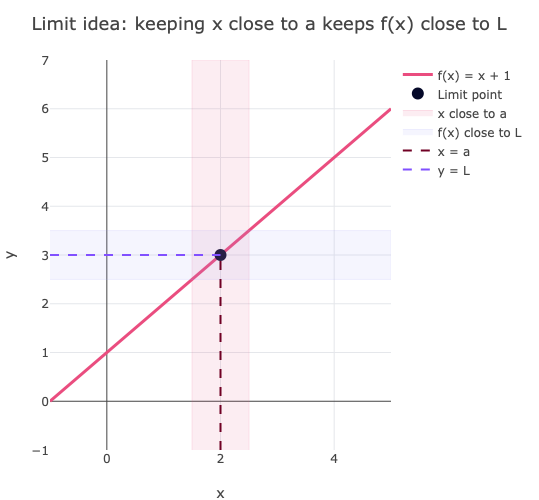
In the graph above, the vertical band shows values of $x$ close to $a$.
The horizontal band shows values of $f(x)$ close to $L$.
The idea is that when $x$ stays close enough to $a$, the function values stay close to $L$.
11. One-Sided Limits and Two-Sided Limits Summary
12. How to Decide if a Limit Exists
To decide whether: $$\lim_{x \to a} f(x)$$
exists, check the one-sided limits.
First, find: $$\lim_{x \to a^-} f(x)$$
Then, find: $$\lim_{x \to a^+} f(x)$$
If they are equal, the two-sided limit exists.
If they are not equal, the two-sided limit does not exist.
Symbolically: $$\lim_{x \to a} f(x) \text{ exists if } \lim_{x \to a^-} f(x)=\lim_{x \to a^+} f(x)$$
13. Practice Examples
Practice Example 1
Suppose: $$\lim_{x \to 4^-} f(x)=7$$
and: $$\lim_{x \to 4^+} f(x)=7$$
Since both one-sided limits are equal: $$\lim_{x \to 4} f(x)=7$$
Practice Example 2
Suppose: $$\lim_{x \to -1^-} f(x)=3$$
and: $$\lim_{x \to -1^+} f(x)=9$$
Since the one-sided limits are not equal: $$\lim_{x \to -1} f(x) \text{ does not exist}$$
Practice Example 3
Suppose a graph has a hole at $(2,5)$, but the graph approaches that hole from both sides
Then: $$\lim_{x \to 2} f(x)=5$$
The function might not be defined at $x=2$, but the limit still exists.
Practice Example 4
Suppose: $$f(3)=10$$
but the graph approaches $6$ from both sides as $x$ approaches $3$
Then: $$\lim_{x \to 3} f(x)=6$$
and: $$f(3)=10$$
The function value and the limit do not have to be the same.
14. Final Key Idea
A limit describes what a function approaches.
A left-hand limit describes what the function approaches from the left.
A right-hand limit describes what the function approaches from the right.
A two-sided limit exists only when the left-hand and right-hand limits are equal.
Most importantly:
The limit depends on what happens near the point, not necessarily what happens exactly at the point.
Ready to practice?

Turn this lesson into real progress with adaptive practice that responds to how you're learning and helps guide you toward mastery.